

Omega-3 fatty acids, especially EPA and DHA, are vital for brain health, heart function, and reducing inflammation. But with 90% of fish stocks overexploited and farmed fish losing omega-3 content due to plant-based feeds, it's harder than ever to meet daily needs. Wild-caught fish offers natural omega-3s but raises concerns about mercury and microplastics.
Cultivated seafood offers a promising solution. By engineering omega-3s directly into the product, it can provide higher nutrient concentrations without relying on overfished oceans. Methods like adding omega-3s to culture media, genetic engineering, and precision fermentation are being developed to ensure nutritional parity with traditional seafood. However, challenges like cost, oxidation, and regulatory hurdles remain. By 2026, omega-3-enriched cultivated seafood could become a reality, offering a cleaner, controlled alternative to conventional fish.
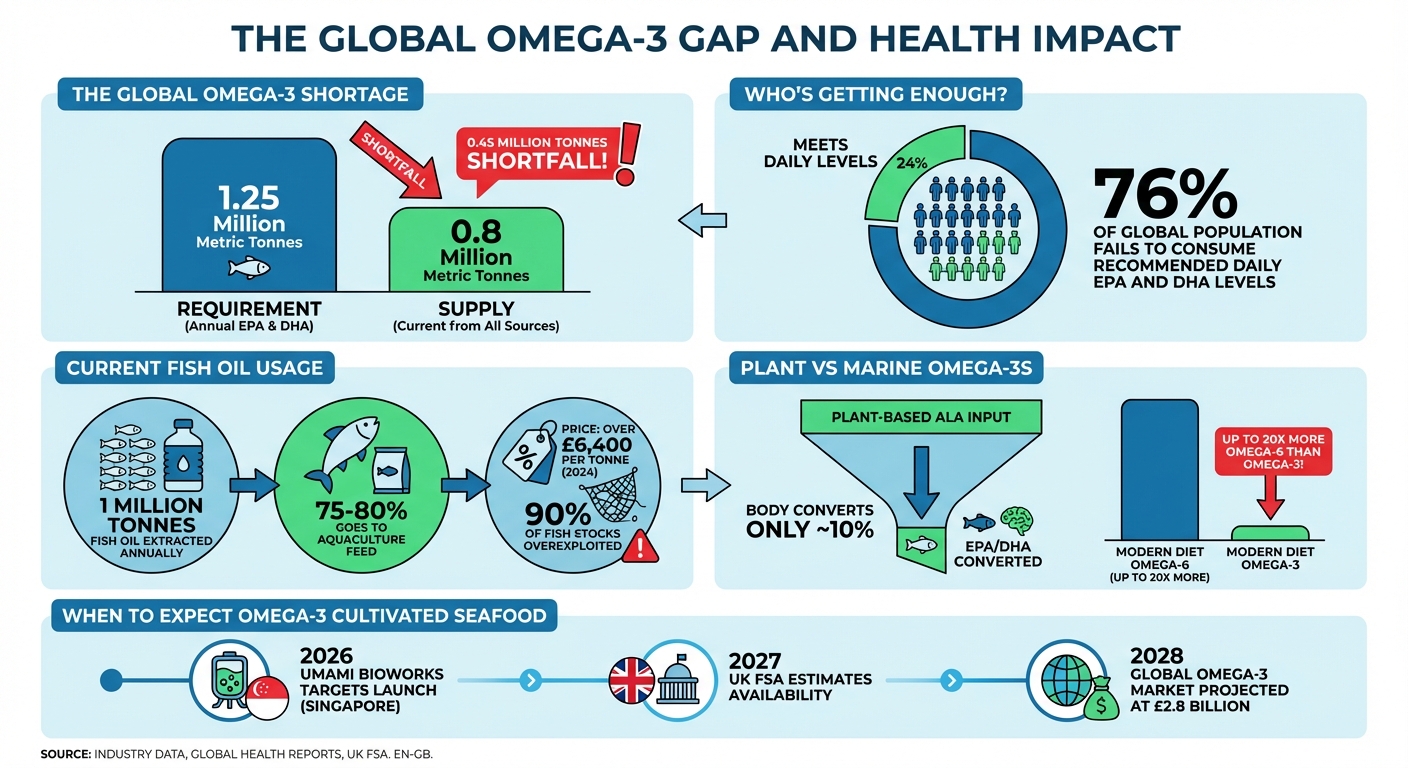
The Global Omega-3 Gap: Supply vs Demand and Key Health Statistics
Why Omega-3 Fatty Acids Matter for Health
What Omega-3s Do in the Body
Omega-3 fatty acids, particularly EPA (eicosapentaenoic acid) and DHA (docosahexaenoic acid), are essential for many critical functions in the body. However, your body isn’t great at producing these on its own. In fact, it can only convert around 10% of plant-based ALA (alpha-linolenic acid), found in foods like flaxseeds and walnuts, into EPA and DHA [13].
"Your body can't make EPA and DHA very well on its own - and it struggles to convert plant-based ALA into these long-chain forms. That's why getting EPA and DHA directly from seafood is the most efficient and effective way to support your health." – Marsh Skeele, Co-founder, Sitka Seafood Market [6]
EPA and DHA play a key role in brain development, cognitive function, and maintaining the structure of cell membranes. They also help regulate blood pressure, lower triglycerides, and reduce the risk of stroke and cardiovascular disease [6][7]. On top of that, these fatty acids combat inflammation and promote tissue healing - an especially important benefit given that many modern diets include up to 20 times more omega-6 fats than omega-3s, which can create an imbalance [12].
Despite their importance, most people aren’t getting enough. A staggering 76% of the global population fails to consume the recommended daily levels of EPA and DHA [10]. This deficiency can show up in various ways, including dry skin, brittle hair, joint pain, and even a higher risk of anxiety and depression [9][11]. For pregnant individuals, not getting enough omega-3s can affect the cognitive and neurological development of their baby [10].
Getting enough omega-3s is clearly important, but relying on conventional seafood to meet these needs is becoming more difficult.
Problems with Getting Omega-3s from Conventional Seafood
The ability of conventional seafood to provide sufficient omega-3s is being compromised by several factors. One major issue is the aquaculture industry’s increasing use of plant-based feeds, which don’t contain EPA and DHA. As a result, farmed fish now have lower omega-3 levels, meaning you’d need to eat larger portions to get the same nutrients that smaller servings provided just a decade ago [5][8].
Currently, aquaculture consumes about 75% of the global fish oil supply [5], and fish oil prices have soared to over £6,400 per tonne as of 2024 [8]. These economic pressures are pushing the industry further towards cheaper, lower-omega-3 feed options.
Wild-caught seafood, while naturally higher in omega-3s, comes with its own set of problems. Mercury and microplastic contamination are growing concerns [6]. Meanwhile, overfishing and the strain on marine ecosystems make wild seafood an increasingly unreliable source for meeting nutritional needs.
Given these challenges, it’s clear that alternative solutions are needed to ensure people can access enough EPA and DHA. This is where omega-3-enriched cultivated fish could play a game-changing role.
sbb-itb-c323ed3
Current Omega-3 Sources and Their Drawbacks
Marine-Based Sources
Wild-caught fish and farmed seafood continue to dominate as the main sources of EPA and DHA for most people, but both come with serious challenges. Wild fisheries have reached or exceeded sustainable harvesting limits, making them an increasingly unreliable option for meeting global nutritional demands. To put this into perspective, the annual requirement for EPA and DHA to meet health guidelines is around 1.25 million metric tonnes, but the current supply from all sources barely exceeds 0.8 million metric tonnes [5][14].
"There is a major chronic shortfall in EPA and DHA to supply human requirements and demand." – M. Sprague et al., Institute of Aquaculture, University of Stirling [5]
Farmed fish can sometimes help bridge this gap since they often contain 60% to 100% more total fat than their wild counterparts, which can compensate for lower percentages of omega-3s. However, this is not a perfect solution. Wild-caught fish carry risks of contamination from heavy metals, PCBs, and dioxins [14]. While switching farmed fish to plant-based feeds can reduce these contaminants, it also diminishes their omega-3 content - a difficult trade-off for both consumers and producers [5][14].
These issues highlight the need for alternatives like cultivated seafood entering the market, as current marine sources are struggling to keep pace with demand.
Plant-Based and Algae-Derived Omega-3s
Plant-based and algae-derived sources provide alternative ways to obtain omega-3s, but they come with their own set of challenges. Terrestrial plants like flaxseeds and chia seeds are rich in alpha-linolenic acid (ALA), but ALA is not the same as EPA and DHA. The human body has limited ability to convert ALA into these essential long-chain fatty acids - a limitation shared by many fish species [2][5]. On the other hand, microalgae, the original producers of EPA and DHA, offer a direct source of these nutrients, as they are passed up the food chain to fish [2][5].
Algae-derived omega-3 supplements bypass the need for fish entirely, providing EPA and DHA with minimal contamination risk [2]. However, two major roadblocks hinder their widespread use. First, cost remains the most significant challenge for companies trying to incorporate these ingredients [2]. Second, omega-3s from all sources are highly prone to oxidation, which leads to unpleasant flavours and reduces shelf life [2]. These technical and financial barriers have slowed the adoption of algae-based omega-3s, even though they offer clear environmental benefits.
"The availability of omega-3 ingredients could represent a substantial future bottleneck to the scale-up of nutritionally-equivalent alternative seafood products." – Good Food Institute [2]
How Omega-3s Are Added to Cultivated Seafood
Ingredient Formulation and Bioconversion Methods
Cultivated seafood producers have developed several techniques to ensure their products contain the omega-3 fatty acids consumers expect. One of the simplest methods involves directly adding EPA and DHA to the culture media where cells are grown. Since these fatty acids don’t dissolve well in water, they are typically combined with bovine serum albumin (BSA) or animal-free substitutes. This approach has proven effective, achieving omega-3 concentrations as high as 1,000 μM [1].
Another method uses liposomal delivery systems, allowing omega-3s to integrate effectively into the culture media. For whole-cut seafood products, omega-3s are incorporated into growth scaffolds, which mimic the structure of natural tissues [1].
Some companies are turning to bioconversion techniques, imitating the natural processes fish use to produce omega-3s. For instance, Atlantic salmon hepatocytes can convert about 45% of alpha-linolenic acid (ALA) into longer-chain omega-3s, with 20% of that becoming DHA [1]. This method relies on less expensive precursor ingredients rather than pre-formed EPA and DHA, but it requires more intricate co-culture setups.
A more advanced approach involves genetic engineering, where cells are modified with genes for desaturases and elongases to produce omega-3s directly. While this could significantly lower ingredient costs in the future, it faces regulatory challenges [1][15]. Companies like Singapore-based Umami Bioworks are already using AI tools to refine marine cell cultivation processes that naturally generate omega-3s, aiming for commercial availability by 2026 [4].
These strategies provide a foundation for tackling the next big hurdle: maintaining omega-3 stability during production.
Encapsulation and Stability Techniques
Ensuring omega-3s remain stable throughout the production process is a complex challenge. These fatty acids are prone to oxidation when exposed to oxygen, which can lead to unpleasant flavours and reduced nutritional value [1][16]. Encapsulation methods - such as using liposomes or storing omega-3s as triglycerides - help shield them from degradation [16].
Interestingly, research has shown that high DHA levels can inhibit cell growth in tuna cultures. However, adding Vitamin E counteracts this effect by reducing oxidative stress [1]. This discovery has encouraged producers to include antioxidants alongside omega-3s, ensuring both cell health and nutrient integrity. Timing also plays a crucial role; fatty acids added during final processing may not fully integrate into the cells [1].
"The method by which LC omega-3 PUFAs are added may impact the quality of the final product... it will be essential to determine what conditions lead to high cellular uptake and what impact this has on the quality and stability." – Good Food Institute [1]
As the industry expands, recycling and reusing omega-3 ingredients from culture media will become essential to manage costs effectively [1].
New Methods for Producing Omega-3s
Precision Fermentation for Omega-3 Production
New advancements in omega-3 production are now leveraging precision fermentation and controlled cultivation systems. Precision fermentation involves using engineered microorganisms to produce omega-3 fatty acids on a large scale, bypassing the need for ocean resources. A key player in this process is the yeast Yarrowia lipolytica, which naturally stores significant amounts of intracellular lipids. By introducing specific biosynthetic enzymes and blocking competing pathways like β-oxidation, these microorganisms can be fine-tuned to synthesise EPA and DHA efficiently [16][17].
For example, engineered Yarrowia lipolytica has achieved EPA levels as high as 56.6% of its total fatty acids. DuPont has commercialised this technology with its "New Harvest™ EPA oil", developed through multi-gene engineering [16][17]. This method not only provides a stable, year-round omega-3 supply but also eliminates concerns about contaminants like mercury and microplastics.
Another innovation is cell-free systems (CFS), which use purified enzymes or cell extracts - sometimes referred to as "programmable liquids" - to produce omega-3s. Without the need to sustain living cells, CFS offers precise control over fatty acid production and could potentially achieve higher concentrations without the toxicity challenges associated with live-cell systems [17].
These cutting-edge methods are complemented by other approaches utilising marine microorganisms to expand the range of omega-3 production options.
Marine Microorganisms and Land-Based Algae
Nature-based cultivation methods provide another pathway for omega-3 production. Marine microalgae and bacteria, the original producers of omega-3s in the ocean, are now being cultivated directly in controlled environments. Since fish accumulate omega-3s by consuming these microorganisms, this approach skips the marine food chain and ensures a sustainable, contaminant-free source of these essential fatty acids [16][17].
One method, heterotrophic fermentation, involves growing microalgae in dark fermenters using organic carbon, producing high cell densities with lipid contents ranging from 20% to 70% of dry weight [16]. Companies like Vaxa (Örlo Nutrition) are using indoor photobioreactor systems to cultivate pollutant-free microalgae, offering a clean and sustainable alternative [18].
Plant molecular farming is also gaining traction. Yield10 Bioscience, in collaboration with Rothamsted Research, has engineered Camelina sativa plants to produce around 20% EPA and DHA, mimicking the profile of northern fish oils. After four years of field trials across the UK, US, and Canada, these transgenic plants have proven equivalent to natural fish oils for both salmon feed and human consumption. This agricultural approach could provide a scalable and economical alternative. Professor Johnathan Napier of Rothamsted Research remarked:
"I can't imagine that any system that relies on cell culture could compete economically with a plant-based approach... agriculture always comes out on top" [18].
These methods, whether through precision fermentation or algae cultivation, directly tackle issues like supply instability and contaminants while enhancing the nutritional quality of cultivated seafood.
3MMI - Cell-Cultivated Salmon: A Future-Ready Fish
When to Expect Omega-3-Enriched Cultivated Seafood
Efforts to improve omega-3 delivery in cultivated seafood are advancing, and timelines are emerging for when consumers might see these products on shelves.
Timelines for Commercial Availability
The UK Food Standards Agency (FSA) has suggested that cultivated seafood and meat products could become available in the UK by 2027. This estimate reflects the progress being made in regulatory approvals across various markets as companies navigate the complex processes required to bring these products to consumers.
Meanwhile, Singapore-based Umami Bioworks has its sights set on 2026 for launching cultivated meat products globally, in partnership with established brands. In November 2025, the company introduced a line of cell-cultured marine supplements using its AI-powered "Alkemyst" platform. This technology leverages machine learning and computational biology to cultivate marine cells that naturally produce omega-3s, collagen peptides, and vitamin B12. Earlier, in July 2024, Umami Bioworks registered two cultivated whitefish ingredients with the EU Feed Materials Register for pet food applications and is aiming for a Q2 2026 launch, pending approval for human consumption in Singapore [4].
However, achieving these timelines is not without obstacles. Production costs for long-chain omega-3 ingredients remain high, and oxidation risks pose challenges for maintaining quality. While algae remains the go-to source for omega-3s, companies are exploring more affordable options like precision fermentation and plant molecular farming to avoid supply issues. To tackle oxidation - responsible for off-flavours, reduced shelf life, and nutrient degradation - producers are employing advanced encapsulation methods and incorporating antioxidants like Vitamin E during processing.
These production advancements aim to meet the high nutritional standards consumers expect from seafood alternatives.
Meeting Consumer Nutritional Expectations
Despite the hurdles, producers are determined to offer cultivated seafood that matches the nutritional value of its wild-caught counterparts. A 2023 industry survey revealed that nearly all alternative seafood companies plan to achieve nutritional parity with conventional seafood within five years [2]. This means more than just adding omega-3s - it involves replicating the same levels of EPA and DHA found in wild fish while eliminating contaminants like mercury, microplastics, and antibiotics.
This commitment resonates with consumers seeking healthier and cleaner options than traditional meat. Mehaa Bajaj, Product Manager at Umami Bioworks, highlighted the broader vision:
"Vegetarians and plant-forward consumers shouldn't have to compromise their health. We've built a platform that recreates the ocean's most powerful nutrients without relying on the ocean" [4].
This approach is particularly important for those who struggle to get enough EPA and DHA from plant-based sources alone.
Transparency is another key focus. Companies are working to ensure clear labelling that specifies fatty acid profiles, distinguishing between ALA (from plants) and EPA/DHA (marine-derived). This avoids vague claims like "high in omega-3s" and helps consumers make informed choices [2]. Such clarity is crucial as the global omega-3 market is expected to reach nearly £2.8 billion by 2028 [16].
Conclusion
Cultivated seafood offers a promising alternative to traditional fishing methods, reducing the strain on wild fish populations. This includes the development of sustainable cultivated crustaceans like prawns and crab. By addressing some of the challenges discussed earlier, this controlled production method ensures seafood free from contaminants like mercury, microplastics, and antibiotic-resistant bacteria. Additionally, cultivated seafood can be tailored to meet - or even exceed - recommended nutritional standards [19].
"Cell-cultivated seafood also provides options for the fortification of fish meat with healthier compositions, such as omega-3 fatty acids and other beneficial nutrients through scaffold, media or cell approaches." [19]
This innovation could help close the global omega-3 gap. While the annual demand for omega-3s is around 1.25 million tonnes, the total supply from all sources currently falls short at just 0.8 million tonnes [5]. At the same time, about one million tonnes of fish oil are extracted from the oceans each year, with 80% of it going toward aquaculture feed [20]. Cultivated seafood offers a way to produce omega-3s sustainably without further depleting marine resources.
As producers work toward achieving the same nutritional profile as wild-caught seafood - and aim to reach this goal within five years [2][3] - cultivated seafood is becoming a viable solution to both environmental challenges and consumer health needs. While cost and regulatory hurdles remain, the ability to create clean, omega-3-rich seafood without harming ocean ecosystems is within reach. These advancements make cultivated seafood a forward-thinking option for meeting the demands of a growing population. For more updates on this emerging field, visit Cultivated Meat Shop.
FAQs
Will cultivated seafood have as much EPA and DHA as wild fish?
Cultivated seafood is being developed to match the levels of EPA and DHA found in wild fish. This is important because studies indicate that farmed salmon often contains lower amounts of these essential omega-3 fatty acids, largely due to changes in their feed. By incorporating algal oils into the production process of cultivated fish, it's possible to boost EPA and DHA levels, offering an appealing alternative to traditional options.
How will omega-3s be kept from oxidising and tasting “fishy”?
Omega-3s in cultivated seafood can be safeguarded against oxidation and the development of an unpleasant "fishy" taste. This is achieved by incorporating antioxidants, employing advanced manufacturing processes, and ensuring proper storage. These approaches minimise exposure to oxygen, heat, and light - three primary culprits behind oxidation and rancidity.
When will omega-3-rich cultivated seafood be available in the UK?
Omega-3-rich cultivated seafood is anticipated to hit shelves in the UK once the products are fully developed and ready for market introduction. With ongoing advancements in technology and improvements in supply chains, this could happen in the near future.


