

Cultivated meat is expensive, and growth factors are a major reason why. These proteins, like FGF2 and IGF1, are essential for cell growth but account for up to 99% of production costs. The challenge? They're costly to produce, degrade quickly, and require frequent replenishment.
Efforts to cut costs focus on:
- Engineering cells to produce their own growth factors.
- Using food-grade growth factors instead of clinical-grade ones.
- Improving media design and nutrient delivery to reduce waste and extend protein lifespan.
These innovations could slash growth factor costs by up to 1,000 times, making cultivated meat more affordable for consumers.
Why Growth Factors Are So Expensive
The Cost of Recombinant Protein Production
Producing growth factors is a complex process due to the precise conditions required for their functionality. These proteins need to fold correctly and undergo modifications like glycosylation and disulfide bonding to be biologically active. Each step in this process adds to the production cost.
To save time and money, many manufacturers use engineered bacteria like Escherichia coli to produce these proteins. However, E. coli often struggles with complex proteins, resulting in low solubility or inactive aggregates. For more intricate growth factors, such as TGF-β1, mammalian cell lines like Chinese Hamster Ovary (CHO) cells are necessary to ensure proper folding. While effective, CHO cell-derived proteins are far too expensive for large-scale applications like food production. After production, the proteins must undergo high-purity purification using costly chromatography methods, further increasing expenses [2].
"The primary challenge lies in the economic viability of making cultivated meat cost-competitive with traditional meat... culture media is the major contributor to production cost." - BMC Microbial Cell Factories [2]
Adding to the difficulty, these proteins degrade quickly, making their production even less cost-efficient.
Short Half-Life and Frequent Dosing
Even after the painstaking process of production and purification, growth factors have a short lifespan in cell culture media. Their half-life can range from just a few minutes to several days. Factors like enzymatic activity, temperature, and pH in bioreactors speed up their degradation. This means producers must either add higher initial concentrations or frequently replenish the media to maintain effectiveness [1].
Another challenge is that many growth factor molecules never reach their intended targets. Instead, they float freely in the media, leading to significant waste [4].
"The high in-vitro concentrations are required to offset the troughs of growth factor availability that occur as growth factor proteins degrade in in vitro culture systems." - Cell Guidance Systems [1]
This constant need to replace degraded growth factors further inflates production costs.
Growth Factors as the Biggest Media Cost Driver
The intricate production process, purification demands, and rapid degradation make growth factors the most expensive component of cell culture media for cultivated meat. A 2018 study of "Essential 8" serum-free media revealed that 99% of its £373-per-litre cost came from just four ingredients: FGF2, TGF-β, insulin, and transferrin [4].
| Media Type | Growth Factor Cost per Litre | % of Total Media Cost |
|---|---|---|
| Essential 8 (Baseline, 2018) | £369.27 | 99% |
| B8 Media (Lab scale) | £2.75 | 25% |
| Beefy-9 Media | £45–£130 | >50% |
| In-house Produced GF Media | £0.82 | 4% |
When growth factors are purchased at commercial rates, they dominate the overall media cost. However, researchers are exploring ways to reduce these expenses. For example, a 2022 study from Aarhus University and the University of Toronto demonstrated that producing growth factors in-house with optimised E. coli systems could cut their cost from £196 per milligram to just £7.47 per milligram. This reduced their share of media costs from 95% to only 4% [4][5].
"Mitogenic protein growth factors (GFs) are essential components of growth medium and account for upwards of 90% of the total costs." - Meenakshi Venkatesan, Researcher, Aarhus University [5]
These insights underline why growth factor optimisation is critical for reducing costs in cultivated meat production and pave the way for innovative strategies discussed in the next section.
sbb-itb-c323ed3
How Producers Are Cutting Growth Factor Costs
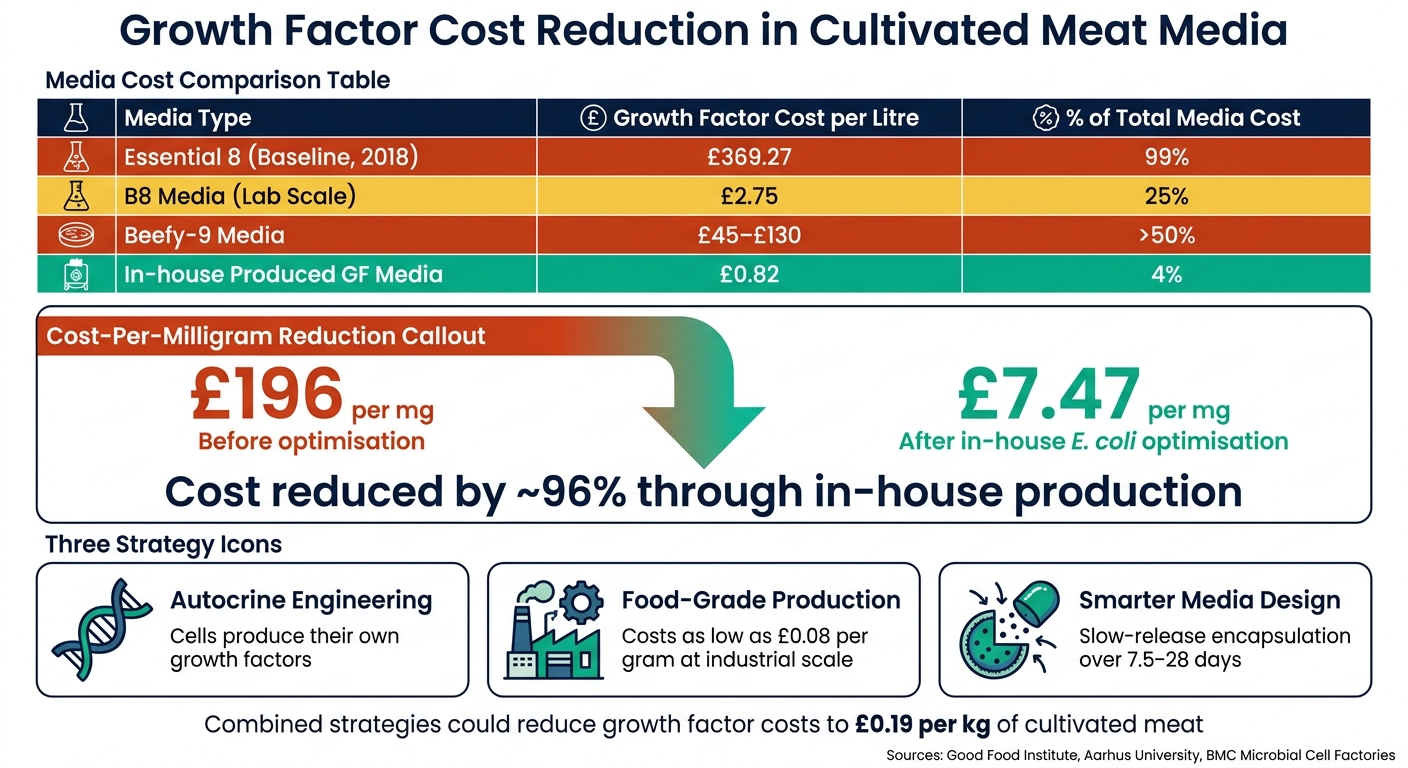
Growth Factor Cost Reduction in Cultivated Meat Media
Reducing the cost of growth factors is a critical step in making cultivated meat more affordable. Since these proteins make up a large portion of media expenses, producers are using several strategies to cut costs. Each method contributes to lowering the overall production expenses for cultivated meat.
Engineering Cells to Produce Their Own Growth Factors
A promising strategy is engineering cells to produce their own growth factors, a process known as autocrine production. Instead of relying on expensive recombinant proteins added to the media, the cells become self-sufficient. This eliminates the need for external supplementation and bypasses the costly supply chain associated with recombinant proteins. By reducing these external inputs, producers can significantly improve cost efficiency, bringing cultivated meat closer in price to conventional options.
Transitioning to Food-Grade Growth Factors
Another approach involves shifting to food-grade growth factors, which focus on achieving reasonable purity levels rather than meeting clinical-grade standards. Techniques like silica-binding tags and pH-responsive precipitation make this process more cost-effective [2]. This adjustment allows for industrial-scale production, significantly lowering costs.
The impact of scaling up is substantial. Producing growth factors at volumes similar to industrial enzymes - like those used in laundry detergents - could bring costs down to around £0.08 per gram [1].
"The absolute lowest cost of producing growth factors may be as little as approximately £0.08 per gram. This is the cost at which industrial-scale enzymes used in washing detergents are produced." - Good Food Institute [1]
Using species-specific growth factors also makes a difference. For example, bovine cells require as little as 2 ng/mL of bovine FGF-2, while cross-species variants need much higher concentrations (17.5–70 ng/mL) [6]. Matching the right growth factor to the cell type reduces the amount needed, cutting costs further and making cultivated meat more economically viable.
Smarter Media Design to Reduce Growth Factor Use
Improved media formulations are another way to lower growth factor consumption. In conventional media, most growth factors degrade before they reach the target cells [4]. Addressing this inefficiency can lead to significant savings.
Two innovative solutions tackle this issue. First, tethering growth factors to scaffolds or microcarriers ensures precise delivery to the cells, reducing the quantity required. Second, encapsulating growth factors in chitosan or gelatin microspheres allows for slow, sustained release over 7.5–28 days. This eliminates the need for frequent replenishment and reduces waste [4].
Additionally, researchers are using computational tools like AlphaFold and Rosetta to design growth factor variants that are more stable and degrade more slowly at the 37°C temperatures typical of bioreactors (see the top 7 bioreactor designs for more on efficiency) [2]. These longer-lasting growth factors require less frequent additions, amplifying cost savings throughout the production process and helping to lower the final price of cultivated meat.
What Lower Growth Factor Costs Mean for Cultivated Meat Prices
How Combined Approaches Bring Costs Down
A mix of strategies is helping to slash costs in the cultivated meat industry. One key method involves engineering cells to produce their own growth factors, cutting out the need to buy them externally. On top of that, switching to food-grade production reduces the expense of any remaining growth factors, while fine-tuning media formulations ensures these growth factors work more effectively. Together, these steps could bring growth factor costs down to as little as £0.19 per kg [4].
The broader goal for the industry is to reduce total media costs to below £0.82 per litre [2], which is considered the tipping point for making cultivated meat commercially viable. Encouragingly, the cost of cell culture media has already dropped significantly. Mark Post, Chief Scientific Officer of Mosa Meat, highlights this progress:
"The cost of the cell culture medium... is hundreds of times cheaper than it was when the cultivated meat sector started out." [3]
These advancements are paving the way for cultivated meat to become more affordable, particularly in the UK market.
What This Could Mean for UK Consumers
The combined effect of these cost-saving measures has the potential to reshape consumer pricing. Current estimates suggest production costs for cultivated meat range between £9 and £45 per kg [1]. While this is still higher than the price of conventional British beef, reducing growth factor costs could help narrow the gap.
As these strategies continue to evolve and scale up, cultivated meat could transition from a niche product found in upscale restaurants to a regular feature in supermarkets. For UK shoppers, this might mean seeing cultivated chicken or beef on store shelves at prices that compete with traditional meat. However, it's worth noting that regulatory approval is another significant challenge. Both production costs and regulatory hurdles need to be addressed before cultivated meat can become widely available in the UK [3].
For those interested in staying updated on these developments, Cultivated Meat Shop offers reliable insights into the progress of cultivated meat.
Conclusion: The Path to Lower-Cost Cultivated Meat
For years, growth factors have been the main driver of high cell culture media costs, creating a significant barrier to the wider adoption of cultivated meat. Tackling this issue has become a key focus in making cultivated meat a commercially viable option.
Companies like Orf Genetics and Future Fields are leading the charge in cutting these costs. Orf Genetics grows growth factors in transgenic barley using renewable geothermal energy, while Future Fields employs fruit flies to achieve similar goals [3]. At the same time, researchers at Newcastle University are exploring macromolecular crowding techniques to reduce the amount of growth factors needed [4]. These advancements mark important steps toward making cultivated meat more accessible.
Mark Post, Chief Scientific Officer of Mosa Meat, has highlighted that the cost of cell culture media has dropped significantly - now hundreds of times cheaper than when the industry first began [3]. This dramatic reduction is reshaping the economic landscape of the sector.
Looking ahead, the next big goal is to bring total media costs below £0.82 per litre, a critical point for commercial success [2]. Experts suggest that growth factor costs could be reduced by a factor of 1,000 through better technology and scaling up production [4]. While reaching these targets will take time, the progress so far shows a clear path forward.
For those in the UK eager to stay informed about these developments and the readiness of cultivated meat for mainstream consumption, Cultivated Meat Shop is a great resource for the latest updates in this rapidly evolving industry.
FAQs
Why are growth factors so expensive in cultivated meat?
Growth factors are a major expense in cultivated meat production because they are high-cost recombinant proteins. These proteins make up roughly 99% of the cell culture media costs, largely due to their complex nature. Current production methods, such as bioproduction or synthetic synthesis, only add to the overall expense. Cutting these costs is crucial to making cultivated meat more accessible and affordable.
Is engineering cells to make their own growth factors safe for food?
Growth factors, such as FGF-2, are produced under rigorous food safety standards and play a key role in cultivated meat production. By engineering cells to create their own growth factors, the process eliminates the need for animal-derived components, ensuring compliance with safety regulations. This approach supports the development of cultivated meat as a viable and sustainable alternative to traditional meat.
How soon could lower growth factor costs reduce UK prices?
Lowering the cost of growth factors could make cultivated meat more affordable in the UK within a few years. Research is focused on reducing these costs by as much as 99% through advancements like self-producing cells and scalable production techniques. If successful, this could bring prices closer to the goal of £8 per kilogram by 2030.


