

My short answer: possibly yes - but only if factories run on low-carbon power. Right now, the case for cultivated meat rests mostly on modelling, not shop-ready UK products. The main trade-off is simple: it may cut emissions, land use and farm pollution, but high electricity use can shrink those gains.
If I were judging it as a shopper today, I’d keep these points in mind:
- Power source is the big one. With renewable electricity, modelling points to much lower warming impact than beef, and in some cases lower than pork and chicken too.
- The headline figures are large. Some estimates suggest 85–92% lower warming impact than beef, 44–53% lower than pork, and 17–29% lower than chicken when production uses renewable electricity.
- It may use far less land. That could leave more space for habitats and nature recovery.
- It may cut manure-related pollution. That means less ammonia and less nitrogen and phosphorus run-off from large herds.
- It is not on sale in the UK yet. Any product will still need Food Standards Agency approval before sale.
- Claims will need checking. I’d look for kg CO₂e per kg, energy-source details, and independent life cycle assessments rather than vague green wording.
Lab-Grown Meat: How Much Can It Help Save Our Climate? | WSJ Tech News Briefing
sbb-itb-c323ed3
Quick Comparison
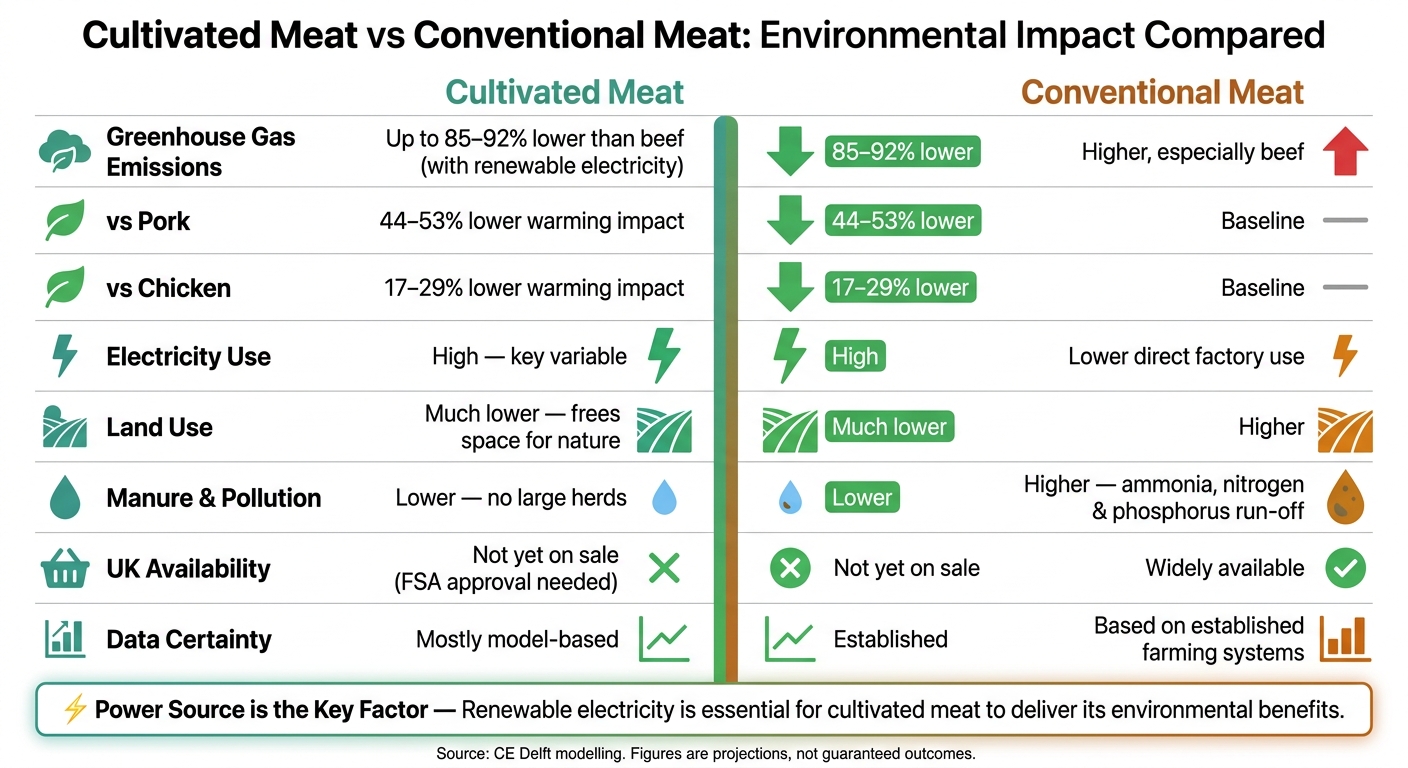
Cultivated Meat vs Conventional Meat: Environmental Impact Compared
| Point | Cultivated meat | Conventional meat |
|---|---|---|
| Greenhouse gas output | Can be much lower, if powered by low-carbon electricity | Often higher, especially beef |
| Electricity use | High, and a key factor | Lower direct factory power need, but animal farming has other heavy inputs |
| Land use | Lower | Higher |
| Manure and slurry pollution | Lower | Higher |
| UK availability | Not yet on sale | Widely available |
| Certainty of data | Mostly model-based | Based on established farming systems |
So my takeaway is simple: cultivated meat is not automatically the lower-impact option. It looks more promising when the power is clean, the producer shares hard numbers, and the claims are backed by independent data.
How Cultivated Meat compares with conventional meat on impact
Most of the sustainability data on Cultivated Meat still comes from modelling rather than large-scale commercial production [1]. So the picture isn’t fixed yet.
The main case for Cultivated Meat is simple: it may cut emissions compared with conventional meat. But there’s a catch. Production can also use a lot of energy and other inputs [1]. That means the final impact depends heavily on how it’s made.
The biggest variables are land, water and energy use. These factors determine the overall environmental benefits of cultivated meat.
Why energy source is the key factor
Out of all the inputs, electricity has the biggest effect on emissions. It's the main swing factor in Cultivated Meat's climate impact [1].
Why fossil-based electricity raises the impact
If production runs on high-energy, fossil-based electricity, its climate benefit gets smaller. Put simply, dirty power can eat into the gains. As production scales up commercially, the outcome depends heavily on both scale and the source of power [1].
Why renewable power improves the outlook
The source of electricity shapes the final climate impact [1]. Renewable electricity changes that picture. The cleaner the power supply, the lower the final climate impact. Beyond energy, understanding the water footprint of meat is essential for a full environmental assessment.
Carbon is only part of the picture. Other factors like land use, water use, and pollution matter too.
Beyond carbon: land, water and pollution effects worth knowing
Land use, water use and pollution matter too, and Cultivated Meat may ease pressure in each area.
Less pressure on land and habitats
Cultivated Meat production needs far less land than conventional livestock, which can free up space for nature restoration and biodiversity[1]. That matters because using less land for farming can change both farm pressure and habitat recovery. Put simply, it leaves more room for habitats to return and for nature restoration to happen.
Lower pollution from manure and run-off
Livestock systems produce slurry and manure. When this is poorly managed, it can release ammonia into the air and send nitrogen and phosphorus into rivers and soils[1]. By removing the need for large herds, Cultivated Meat cuts off those pollution routes at the source. For shoppers, those knock-on effects matter just as much as emissions.
Shoppers should look beyond carbon and weigh land use, water use and nutrient pollution. The next issue is how to judge sustainability claims when these products reach shoppers.
What UK shoppers should take away
For shoppers, the main point is simple: can future products show a lower footprint in real use, not just in theory?
Right now, modelling points in a hopeful direction. Cultivated Meat could have a lower impact than conventional beef, and in some cases pork and chicken too, if production runs on low-carbon electricity. CE Delft modelling suggests renewable electricity could reduce global warming impacts by 85–92% compared with beef, 44–53% compared with pork, and around 17–29% compared with chicken.[9][3][8]
That said, these figures are not a promise. Researchers say results can shift depending on the design of the facility and the energy mix behind it.[2][3][6] So it makes sense to read them as well-informed projections, not fixed outcomes.
This is why the current UK regulatory position matters even before any product reaches the shelves. Cultivated Meat is not yet available to buy in UK supermarkets or restaurants. The Food Standards Agency is still working through its regulatory framework, and products will need full safety assessments before sale.[10][11][12]
How to assess future sustainability claims
When products do reach the UK market, it helps to check a few things on labels, websites, or marketing materials.
- Look for a clear statement about the energy source. Best case: a verified claim of 100% renewable electricity or a verified low-carbon energy mix. This matters because studies show the impact of production depends heavily on whether facilities run on fossil-based electricity or renewable power such as wind and solar.[7][8][9]
- Look for references to independent life cycle assessments (LCAs). These can show measured comparisons for greenhouse gas emissions, land use, and water use against conventional meat.[2][3][4]
- Look for hard numbers, such as kg CO₂e per kg of product or land-use savings versus beef, instead of loose phrases like eco-friendly or sustainable.[2][4][5]
Brands that spell out the assumptions behind their claims are much easier to check.
Where to keep up with the category
If you want updates as the category moves forward, a consumer guide can make life easier. Cultivated Meat Shop is a consumer-focused platform that helps shoppers follow product, sustainability, and availability updates in plain English. You can join the waitlist to be notified when Cultivated Meat products become available in the UK.
FAQs
How much does the power source matter?
The power source is the single most important factor in Cultivated Meat’s footprint. Production happens in controlled bioreactors, and that takes a lot of energy.
If that energy comes from renewables like solar, wind or hydroelectric power, emissions can be up to 92% lower than conventional beef. But the picture changes fast when fossil fuels power the process. In that case, the carbon footprint can climb steeply and may match - or even exceed - that of standard livestock production.
Is Cultivated Meat always greener than chicken or pork?
Not always. Whether Cultivated Meat is greener than chicken or pork comes down mainly to the energy used in production.
It does use less land and water on a steady basis. But producing it in bioreactors takes a lot of energy. If that energy comes from renewables, studies show a drop in global warming impact of 17% compared with chicken and 52% compared with pork. If the process runs on fossil fuels, the carbon footprint can end up higher.
How can I check if a product’s green claims are credible?
Look for clear detail on how impact is measured. Claims should point to peer-reviewed studies, industry reports, or data from pilot plants and techno-economic models.
It also helps when a company spells out the main drivers behind its numbers, such as energy use and production methods. And if it uses standard approaches like cradle-to-gate life cycle assessments, that’s a good sign too.
Cultivated Meat Shop offers educational resources on these topics.


