

My main takeaway: cultivated meat could use less land, but its climate footprint depends on how it is made. Before trusting a claim, I check the energy source, nutrient inputs and meat used for comparison.
One 2011 model projected 99% lower land use - but that was a forecast, not a measured factory result. Across the studies, I look for these distinctions:
- Land and nitrogen pollution: usually lower, though land needs protection or restoration for nature to gain.
- Climate: more scope for savings against beef; less clear against pork and chicken.
- Water and energy: results vary with location, ingredients and factory needs.
- Fair comparisons: the same supply-chain stages and units, such as per kilogram of food or protein.
I treat every figure as a scenario, <u>not a product guarantee</u>. These studies also cannot tell you whether a product tastes good, is safe, or meets your nutritional needs or fits your budget.
Dr. Elliot Swartz: The environmental impacts of cultivated meat production
Dr. Swartz's insights align with recent cradle-to-gate data comparing cultivated meat vs beef, which highlights the critical role of energy sources in determining overall sustainability.
sbb-itb-c323ed3
2. What Studies Generally Find
Lower land use is the most consistent finding. Results for climate, water and energy are less certain.[1][11][12] The table below sets out the main differences.
| Measure | Typical finding | Main qualification |
|---|---|---|
| Land use | Usually lower | Benefits for nature depend on restoration or protection. |
| Nitrogen-related pollution | Often lower | Nutrient ingredients and wastewater treatment matter. |
| Climate impact | Greater scope for climate savings compared with beef | Electricity, heat and production efficiency shape results. |
| Water use | Varies | Local water availability matters. |
| Energy demand | Potentially higher | Cultivation, cooling, cleaning and nutrient production require energy. |
These are trends, not guarantees.
Land Use and Nitrogen Pollution
Cultivated Meat can avoid much of the land needed for grazing, feed crops and livestock housing. But freeing up land only helps nature if that land is restored or protected. The main finding is lower land use - not a promise that nature will recover.[12][14]
Studies also often project less nutrient pollution by avoiding much of the fertiliser and manure associated with livestock. That does not mean all pollution falls. Producing culture-medium ingredients and treating wastewater still have costs for the environment.[1][10][11]
Climate Impact, Water Use and Energy Demand
Energy use changes the comparison. There is more scope for climate savings against beef because cattle produce methane during digestion and need feed and land. Pork and chicken are closer comparisons, so results vary more.[8][12][13]
Electricity and heat for mixing, cooling and cleaning can increase energy demand. Low-carbon energy improves climate results, even when the amount of energy needed stays the same.[8][12][13]
For water claims, check what the study counts. Does it include process water, cleaning and ingredient production, or just water used at the factory? Look for a water-scarcity measure that accounts for local conditions.[1][9] Any reported gains remain possible savings, not guarantees.
3. Why Study Results Differ
Study results vary because they start with different assumptions. A strong result on paper can change when those assumptions change. The biggest differences usually come from energy use, production scale and what each study counts.
Energy Supply, Production Scale and Nutrients
Studies use different assumptions about electricity sources, equipment efficiency and factory utilisation. They also vary in how much growth medium - the nutrient mix cells need - is required, and how often it is replaced or reused. These choices affect whether Cultivated Meat performs better or worse than conventional meat in terms of waste and emissions.
Future factory efficiency is a projection, not a measured result. Factories would need to reach the assumed scale and efficiency for those projections to hold.[15][17]
Comparison Meat and Supply-Chain Coverage
The benchmark matters as much as the meat type. A study may favour Cultivated Meat because of the meat chosen for comparison or because it leaves out certain supply-chain stages. These choices - the benchmark and the system boundary - can change the headline result. Check that both match before comparing studies.
| Study assumption | Why results differ |
|---|---|
| Energy mix and efficiency | Cleaner power and lower energy use can improve climate results. |
| Capacity, utilisation and medium use | Lower factory utilisation or greater nutrient use can increase impacts per kilogram. |
| Benchmark meat | An advantage over beef may be smaller - or reversed - when compared with some pork or chicken systems.[18] |
| Gases counted and accounting period | Different choices can change the climate comparison.[20] |
Climate figures also depend on which gases a study counts and the period over which it measures their effects. Compare climate claims only when these accounting methods match.[20]
4. Findings From Four Life Cycle Studies
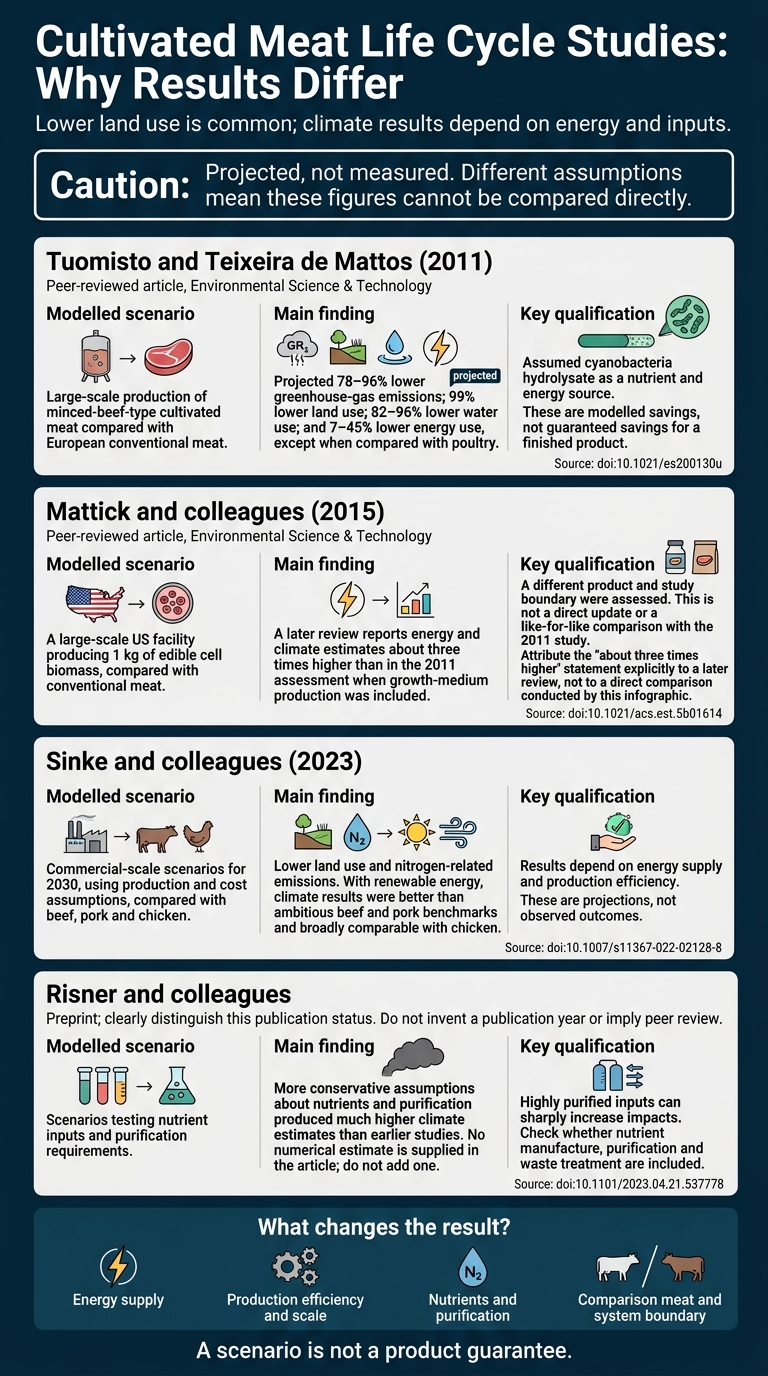
Cultivated Meat Life Cycle Studies: Why Results Differ
These footprints are projected, not measured. Each study uses different assumptions, so the figures cannot be compared directly. Together, they show how changing those assumptions can change the results.
The pattern is clear: lower land use is common, but climate results depend heavily on energy and inputs.
| Study and publication type | Modelled comparison | Main finding | Key limitation |
|---|---|---|---|
| Tuomisto and Teixeira de Mattos (2011) - peer-reviewed article, Environmental Science & Technology. Original paper | Large-scale production of minced-beef-type Cultivated Meat compared with European conventional meat. | Projected 78–96% lower greenhouse-gas emissions, 99% lower land use and 82–96% lower water use. Energy use was 7–45% lower, except when compared with poultry.[7][22] | Assumed cyanobacteria hydrolysate as a nutrient and energy source. These are modelled savings, not guaranteed savings for a finished product.[22][23] |
| Mattick and colleagues (2015) - peer-reviewed article, Environmental Science & Technology. Original paper | A large-scale US facility producing 1 kg of edible cell biomass, compared with conventional meat. | A later review reports energy and climate estimates about three times higher than in the 2011 assessment when growth-medium production was included.[21] | Mattick assessed a different product and used a different study boundary, so these figures are not a direct update.[21] |
| Sinke and colleagues (2023). Original study | Commercial-scale scenarios for 2030, using production and cost assumptions, compared with beef, pork and chicken. | Lower land use and nitrogen-related emissions. With renewable energy, climate results were better than ambitious beef and pork benchmarks and broadly comparable with chicken.[19][16] | Results depend on energy supply and production efficiency. They are projections, not observed outcomes.[19][24] |
| Risner and colleagues - preprint. Original preprint | Scenarios testing nutrient inputs and purification requirements. | More conservative assumptions about nutrients and purification produced much higher climate estimates than earlier studies. | Highly purified inputs can sharply increase impacts. Check whether the assessment includes nutrient manufacture, purification and waste treatment. |
5. Conclusion: How to Judge Footprint Claims
Land savings are the most consistent finding. Results for climate, water and nutrients depend on energy, inputs and scale.[12][19]
Check the Source and Assumptions
Check the source date, scale, energy mix, nutrient inputs, meat used for comparison and system boundary. The comparison needs to be like for like for a footprint claim to mean much.[1][9]
What Life Cycle Studies Cannot Tell Us
These studies assess environmental footprints, not the whole product. They do not establish taste, safety, nutrition or price. A model of future production also cannot prove how a specific product will perform in practice. Those questions need separate evidence, including nutritional analysis, safety assessments and pricing information.[6]
Cultivated Meat Shop is a consumer education resource, not a manufacturer or verifier of footprint claims.
FAQs
How can I check a Cultivated Meat climate claim?
Check the facility’s energy source: renewable energy can cut emissions by up to 92% compared with conventional beef [1][2]. Then check what the study covers. Does it include distribution and infrastructure, or just the energy and resources used to run the facility [3][1]?
Growth media matter, too. Whether the facility uses food-grade or pharmaceutical-grade ingredients can have a large effect on its carbon footprint [4].
For help understanding these emissions benchmarks, visit Cultivated Meat Shop.
Does lower land use mean better biodiversity?
Yes, using less land generally helps biodiversity because it reduces pressure on natural habitats. Conventional livestock farming needs large areas for grazing and growing feed crops. Cultivated Meat can use up to 90–95% less land than conventional beef farming in some cases.
That smaller land footprint leaves more room to restore habitats and support rewilding. It also reduces demand to convert land for farming - a major driver of biodiversity loss.
What evidence would confirm Cultivated Meat’s projected benefits?
Confirmation needs data from large-scale commercial production, not just early-stage models. That means evidence that facilities use 100% renewable energy, so energy use doesn’t cancel out emissions savings [1][2][3]. It also means showing that effective, low-cost growth media can replace pharmaceutical-grade components while delivering climate benefits and making production financially viable [4][5][2].
Transparent, standardised life cycle assessments must also show that production consistently saves energy, water and land at scale [5][2].


