

Cultivated meat is not being held back by interest. It is being held back by cost.
From what I can see, the article points to one simple problem: many people know about cultivated meat, but far fewer would buy it because it is still too expensive and too hard to produce at scale. Awareness is high at 81.92% , often driven by public campaigns, but stated willingness to buy drops to 35.47%. At the same time, funding has fallen from US$900 million in 2022 to US$74 million in 2025, which slows factory build-out and keeps supply low.
If I strip it down, the main points are:
- Price is the biggest barrier to normal supermarket adoption
- Production still costs far too much, with some products costing hundreds of US dollars per burger
- Factories are too small and too few, which limits output
- Larger bioreactors are still a big hurdle, both in cost and in cell growth
- Lower-cost media, better yields, and hybrid products could help cut costs
- Mainstream adoption in the UK depends on three things: affordable prices, steady supply, and retail availability
In short, I’d sum it up like this: cultivated meat will stay a niche product until companies can make more of it, at lower cost, with bigger food-scale production systems rather than small pharma-style setups.
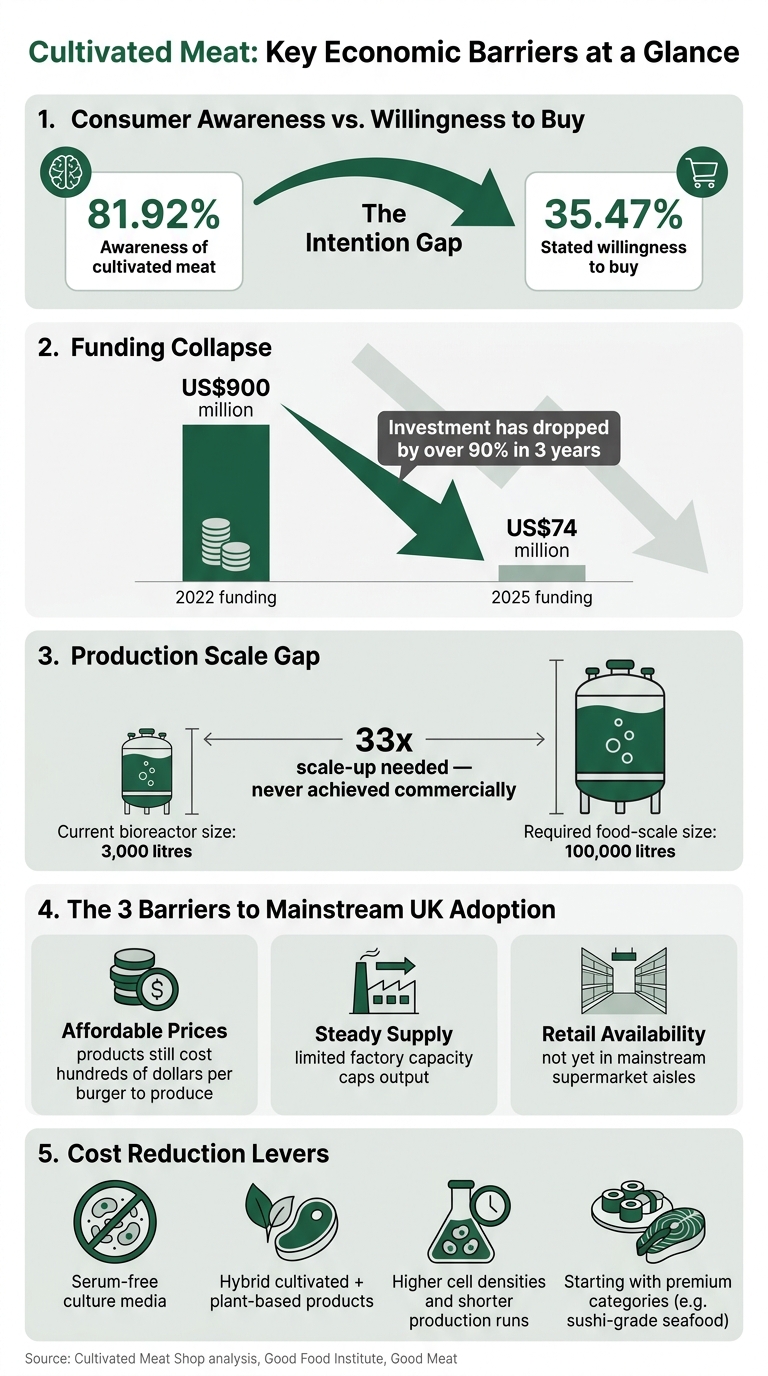
Cultivated Meat: Key Economic Barriers at a Glance
Cost drivers of cultivated meat production
sbb-itb-c323ed3
High production costs are keeping prices out of reach
The main problem is still cost. Production is too expensive for everyday retail, and that keeps prices well above what most people would pay in a normal weekly shop. Recent taste-test products have still cost hundreds of dollars to make [1]. So for now, Cultivated Meat sits more in novelty territory than in the chilled aisle next to regular meat.
Culture media and specialist ingredients are a major cost burden
Cultivated Meat cells need amino acids, growth factors, and other nutrients. That makes culture media expensive from the start. On top of that, these inputs are still produced to very high purity standards, which pushes costs up even more.
Good Meat says serum-free media has brought costs down, but the core inputs are still expensive [1].
So even when one part of the process gets cheaper, the final retail price remains far above conventional meat.
Price parity with conventional meat has not been reached
Even in limited restaurant sales, Cultivated Meat is still sold at a loss [1].
"With every sale it's historic, and with every sale we lose a bit of money." - Joshua Tetrick, CEO, Good Meat [1]
Conventional meat also gets help from entrenched feed subsidies, which makes the price gap even larger. And because production scale is still limited, costs stay high, though economies of scale are expected to drive them down. That’s why cheaper media, better processes, and larger production runs matter next.
Limited equipment and infrastructure are slowing availability
High running costs are only part of the issue. Industrial-scale facilities are still in short supply. So even if inputs became cheaper, output would still be capped by plant capacity.
Bioreactors and factory build-out require large upfront investment
Most Cultivated Meat companies currently use 3,000-litre bioreactors adapted from pharmaceutical production. At food-factory scale, that is still small for food manufacturing. To reach the volumes the market would need, the industry would have to move to 100,000-litre tanks - a 33-fold jump in size that has never been shown at commercial level [1]. Without bigger tanks, unit costs remain too high for mainstream retail.
That jump is not just a matter of buying a larger vessel. At that size, cells still need enough oxygen, and waste still needs to be removed at the right rate—two of the essential metrics for bioreactors. In a 100,000-litre tank, that becomes a serious biological problem that the sector has not yet solved [1].
As Daniel Gertner put it:
"Venture capital in particular is not actually well-suited to fund the scale-up of a company... the funding sources that are well-suited to do that generally look for predictable cash flows, strong balance sheets, [and] on-time and on-budget construction." - Daniel Gertner, Lead Economic and Industry Analyst, Good Food Institute [4]
The equipment supply chain adds another bottleneck. Scaffolds, sensors and growth media often come from scattered general lab suppliers instead of dedicated industrial hubs. That means companies can spend weeks just chasing quotes [2].
Low production capacity means low product volumes
When facilities are small and there are not many of them, output stays low. And when output stays low, prices stay high. It is a bit of a catch-22.
As Meghan McGill put it:
"It is a scale-up loop, where if you want to get to good unit economics, you need to build a larger plant, but in order to build a larger plant, you need money." [3]
Funding for the sector has been falling sharply, which makes it harder for companies to finance the larger plants that could lower costs. That leaves bigger facilities and higher production runs as the next major economic hurdle. From there, the next step is to look at what might bring costs down.
What could bring costs down
Lower-cost media, better processes and larger production runs
These costs can come down, but only if the basics get better: input costs, production yields and batch sizes.
The first big lever is growth media. If companies can swap pricey media for serum-free, enriched versions, costs drop fast. Good Meat scientist Sophia Bou-Ghannam said:
"We've found a way to make an enriched media that completely eliminates the use of serum... That alone has tremendously reduced our media costs." [1]
Researchers are also looking at ways to make amino acids straight from broken-down plant sugars, instead of depending on pricey pharma-grade inputs.
Another route is to make the product simpler. Hybrid products, which blend cultivated cells with plant-based ingredients instead of aiming for a fully Cultivated Meat product, cut the cost per unit. Mission Barns is focusing on cultivated pork fat rather than muscle tissue because fat is easier and cheaper to scale. Bianca Lê, the company's Lead Scientist, said:
"Pork fat brings a juiciness, a deliciousness, but also it's actually much easier to scale and cheaper to grow fat compared to muscle." [1]
Some firms are also starting with high-price categories, such as premium seafood for sushi. That makes sense: early price parity is more within reach there, and shoppers already accept higher prices. Mainstream supermarket shelves come later, not first [1].
How scale changes the economics
Scale shifts the maths in a simple way. Higher cell densities and shorter run times can lift output without adding more factory space. When cells perform better, the same equipment produces more product, and that's where much of the cost drop comes from.
Put plainly: each extra kilogram in a production run pushes the cost per unit down.
Conclusion: What needs to happen before Cultivated Meat goes mainstream
Put simply, scale is the missing piece. Cultivated Meat still runs into three connected barriers: high production costs, costly facilities, and disjointed sourcing. Those are the main reasons it still isn’t widely available in the UK. For shoppers, that means limited availability and prices that are still too high for a normal weekly shop.
That, in turn, makes it harder to fund factory build-outs and equipment upgrades. So scale-up slows, and prices stay high. It’s a bit of a catch-22: without more production, costs don’t fall; without lower costs, it’s hard to finance more production. That capital gap is what keeps large-scale output out of reach.
The next step is clear: larger industrial bioreactor designs, cheaper media, and more efficient production systems. Mainstream adoption depends on lower-cost inputs, bigger batches, and fewer bottlenecks in production. In plain terms, the sector needs food manufacturing methods, not just pharma processes repurposed for food.
The key takeaway for consumers
The main issue isn’t consumer interest. It’s the economics needed to meet that interest. Cultivated Meat will go mainstream only when it is affordable, available, and scaled for everyday UK buying habits. For updates and educational guides, Cultivated Meat Shop offers clear, consumer-focused coverage.
FAQs
Why is Cultivated Meat still so expensive?
Cultivated Meat is still expensive for two main reasons: cell culture media costs a lot, and scaling production is hard.
A big part of the cost comes from the growth factors and amino acids used to keep cells alive. These inputs have, for years, come from the pharmaceutical industry, which makes them very expensive.
There’s also the scale problem. The industry is shifting from small, pharmaceutical-grade bioreactors to much larger systems. That move takes major investment and serious engineering work.
What needs to happen before Cultivated Meat reaches supermarkets?
Before Cultivated Meat shows up on supermarket shelves, the industry has some big economic and technical hurdles to clear. The target is to bring production costs down to about £5.16 per kilogram. That means better bioprocessing, lower-cost food-grade growth media, and production at an industrial scale.
On top of that, companies still need regulatory clearance. They also need clear, open communication to help people feel more at ease about safety and how natural the product seems.
Will Cultivated Meat become affordable in the UK soon?
Not yet. In the UK, cultivated meat is still too expensive for the weekly shop because making it costs a lot and needs heavy investment. The two biggest hurdles are high growth-media costs and a lack of large-scale infrastructure.
That said, prices have come down a lot since 2013. Many companies are now aiming to match the price of conventional meat by 2030. Even then, the first products on sale may still carry a premium price.


